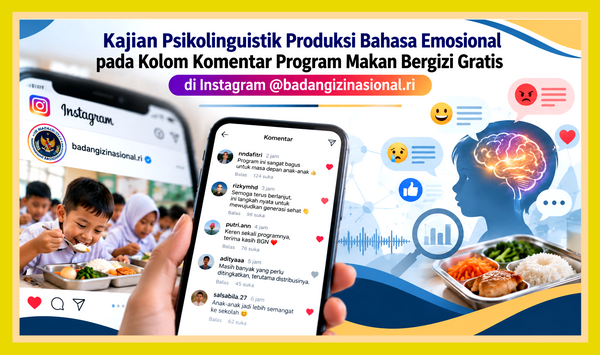
Kajian Psikolinguistik Produksi Bahasa Emosional pada Kolom Komentar Program Makan Bergizi Gratis di Instagram @badangizinasional.ri
DOI:
https://doi.org/10.59638/isolek.v4i2.1006Keywords:
Emotional Language, Psycholinguistics, Language Production, Instagram Comments, Free Nutritious MealsAbstract
This study describes the forms of emotional language in netizens’ comments on an Instagram post by @badangizinasional.ri regarding the Free Nutritious Meals Program (MBG) and interprets textual traces of their production process through a psycholinguistic framework. The study employs a descriptive qualitative approach with a case study design, Ekman's (2003) basic emotion theory, and Levelt's (1989) language production model which includes the stages of conceptualization, formulation, and articulation as an interpretive lens. Data were collected through reading and note-taking using purposive sampling, then coded using an emotion codebook. From a single post, eleven comments were purposively selected as in-depth analytical examples and categorized into six basic emotion categories: happy (2), sad (2), angry (2), afraid (1), disgusted (3), and surprised (1). The distribution across categories does not indicate prevalence. Happiness was evident through expressions of gratitude and hope; sadness through disappointment and concern; anger through harsh language and rhetorical questions; fear through anticipation of negative consequences; disgust through sarcasm and pejorative language; and surprise through expressions of disbelief. Some comments were ambiguous and could be interpreted as belonging to more than one category. The stages of conceptualization, formulation, and articulation can be inferred from implied perceptions, word choice and punctuation, as well as the informal writing style. The findings apply only to the corpus analyzed and are not intended to represent Instagram users or the opinions of the Indonesian public; the language of the comments is interpreted as a trace of emotional expression, not as direct evidence of the speakers’ psychological states.
References
Chaer, A. (2019). Psikolinguistik kajian teoretik. Rineka Cipta.
Dardjowidjojo, S. (2025). Psikolinguistik: pengantar pemahaman bahasa manusia.
Dhien, C. N., Nasrah, S., & Emilda. (2022). Analisis nilai sosial dalam novel Selamat Tinggal karya Tere Liye. DIAJAR: Jurnal Pendidikan Dan Pembelajaran, 1(1), 95–99. https://doi.org/10.54259/diajar.v1i1.208
Ekman, P. (2003). Emotions revealed (1st ed.). Henry Holt and Company LLC.
Farhana, A. T. R., & Sulistyowati, S. (2025). Ekspresi emosional netizen dalam komentar berita selingkuh di komunitas Marah-Marah Twitter. Ilmu Budaya, 9(1), 123–136. https://doi.org/https://doi.org/10.30872/jbssb.v9i1.18883
Kemp, S. (2025). Digital 2025: Indonesia. https://datareportal.com/reports/digital-2025-indonesia
Levelt, W. J. M. (1989). Speaking: from intention to articulation. The MIT Press. https://doi.org/https://doi.org/10.7551/mitpress/6393.001.0001
Margareth, L. M., Sugono, D., & Suendarti, M. (2022). Kesalahan berbahasa dalam pemberian komentar di media sosial Instagram (kajian psikolinguistik). 5(2), 125–135. https://doi.org/http://dx.doi.org/10.30998/diskursus.v5i2.12209
NapoleonCat. (2026). Instagram users in Indonesia September 2026. September. https://napoleoncat.com/stats/instagram-users-in-indonesia/
Nisa, K. (2018). Analisis kesalahan berbahasa pada berita dalam media surat kabar sinar Indonesia baru. JURNAL BINDO SASTRA, 2(2), 218–224. https://doi.org/https://doi.org/10.32502/jbs.v2i2.1261
Palinkas, L. A., Horwitz, S. M., Green, C. A., Wisdom, J. P., Duan, N., & Hoagwood, K. (2015). Purposeful sampling for qualitative data collection and analysis in mixed method implementation research. HHS, 42(5), 533–544. https://doi.org/10.1007/s10488-013-0528-y.Purposeful
Rimé, B. (2009). Emotion elicits the social sharing of emotion: Theory and empirical review. Emotion Review, 1(1), 60–85. https://doi.org/https://doi.org/10.1177/1754073908097189
Sandelowski, M. (2000). Focus on research methods whatever happened to qualitative description? Research in Nursing & Health, 23(4), 334–340. https://doi.org/https://doi.org/10.1002/1098-240X(200008)23:4<334::AID-NUR9>3.0.CO;2-G
Sugiyono, S. (2017). Metode penelitian kualitatif, kuantitatif, dan R&D. Yogyakarta: Auareta.
Sukmadinata, N. S. (2011). Metode penelitian pendidikan: penelitian memberikan deskripsi, eksplanasi, PInovasi, dan Juga dasar-dasar teoritis bagi pengembangan pendidikan. Rosdakarya.
Susanto, D., Risnita, & Jailani, M. S. (2023). Teknik Pemeriksaan Keabsahan Data Dalam Penelitian Ilmiah. QOSIM: Jurnal Pendidikan, Sosial & Humaniora, 1(1), 53–61. https://doi.org/https://doi.org/10.61104/jq.v1i1.60
Susanto, M. R., Nasution, U. B., & Nurlivi, N. (2025). Metodologi penelitian lanjutan (I. K. Sari, Ed.; 1st ed.). PT. Green Pustaka Indonesia.
Syifa, H. D., Ridhwan, M. A., Wulandari, T., & Alfarizi, S. G. (2026). Respons tagar #KaburAjaDulu pada kolom komentar postingan akun Instagram @Ariefnaikkelas. Journal of Language, Literature, and Arts, 6(3), 358–368. https://doi.org/10.17977/um064v6i32026p357-368
Published
How to Cite
Issue
Section
License
Copyright (c) 2026 Sabrina Aulia Firdaus, Intan Feby Putri Yulian, Beyonda Proudy Sujianto, Nur Lailiyah

This work is licensed under a Creative Commons Attribution 4.0 International License.
ISOLEK: Jurnal Pendidikan, Pengajaran, Bahasa, dan Sastra | Fakultas Keguruan dan Ilmu Pendidikan, Universitas Islam Makassar | Jl. Perintis Kemerdekaan Km. 09 No. 29 Makassar, Sulawesi Selatan Indonesia| International Journal of Community Service Learning is licensed under This work is licensed under Lisensi Creative Commons Atribusi 4.0 Internasional.